Beyond locker rooms and fraternities: Imagining better models of masculinity
Last winter, after watching the video from inside the locker room of the US men's hockey team following their gold medal win, I wrote an essay about some of the science and my own observations about masculinity over the last decade. The research, frameworks, and observations I shared that seemed so relevant then, feel even more apt right now, considering what’s come to light at Cornell University.
In the essay, I wrote that misogynistic locker room talk and saying things like "it's just a joke" are the gateway to male violence. As hostile, degrading attitudes, beliefs, and language are normalized, it builds toward worsening, more violent behaviors. Ample research supports this. One study found that exposure to peers who sexually objectify and disrespect women decreases prosocial bystander intervention (Leone & Parrott, 2019). Another study found that exposure to sexist jokes creates an environment in which some men feel comfortable expressing aggressive tendencies toward women (Romero-Sánchez et al., 2021). Many other studies suggest that exposure to sexist jokes increases levels of rape proclivity in men.
Frankly, I believe that a culture that says that jokes and locker room talk at women’s expense is ok is a culture that has said that violence towards women is ok. It’s a culture in which, at a press conference following a huge football game, the room laughs about an AI video of a female reporter being slapped by the head coach (happening after last month’s University of Texas/Ohio State game). It’s a culture in which an ad by major golf brands portrays violence against women (occurring several weeks ago in a Callaway/Good ad). It’s a culture that laughs off comments about assaulting women as “locker room talk.” And it's a culture that not only tolerates men who talk this way, but promotes them to some of the highest offices in the country.
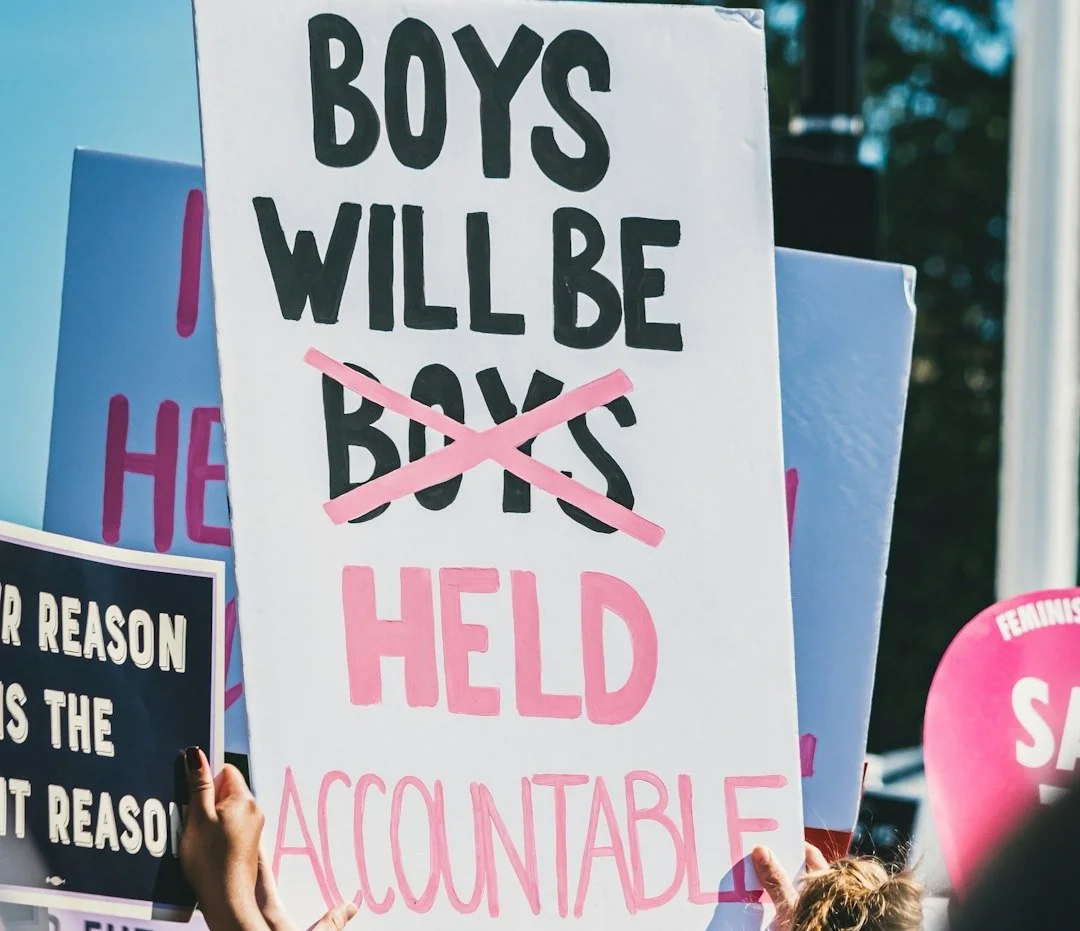
Photo by Gayatri Malhotra on Unsplash
“Not all men,” many men say, when conversations like this come up. I hear what you’re saying. And I’d hope that many of us can name men in our lives who haven’t expressed violence. But the reality is that violence is built into American culture. The perpetrators of violence are overwhelmingly male—as in 9 out of 10. Men currently make up 93% of inmates in America. And 98% of mass shooters are male, according to The Violence Project.
No, not every man is a rapist, but it brings to mind a clip from Trevor Noah’s podcast What Now? Dulcé Sloan, a comedian and a former correspondent on The Daily Show says, “If I'm being attacked, somebody's doing it. But we're not telling the attacker not to attack; we're telling the victim, don't get attacked.” She continues, "How is it that no man has done it, but it has happened to every woman?" And therein lies the problem. We live in a society that’s unwilling to hold attackers accountable, all while telling victims what they should do to prevent getting attacked.
An NBC News investigation, for example, found that less than 4% of reported rapes, sexual assaults, and child sex abuse allegations in certain U.S. cities ever result in a conviction. What’s more, the vast majority of rape and sexual assaults never even get reported. Most of us wouldn’t even know about what happened at Cornell if it wasn’t for the brave journalists at the school’s newspaper, The Cornell Daily Sun, bringing it to light.
Men don’t want to admit that they have violent tendencies, let alone admit that they’re actually violent. But the question that I’m left with is this: How much longer are we men going to continue to allow, perpetuate, and normalize violence? What is your red line? The assault of a friend? Mom? Sister? Partner? Daughter?
In The Will to Change, bell hooks writes:
“This is a patriarchal truism that most people in our society want to deny. Whenever women thinkers, especially advocates of feminism, speak about the widespread problem of male violence, folks are eager to stand up and make the point that most men are not violent. They refuse to acknowledge that masses of boys and men have been programmed from birth on to believe that at some point they must be violent, whether psychologically or physically, to prove that they are men.”
“Love cannot coexist with domination,” hooks writes. We can either dominate and do so at the cost of connection, love, and fulfillment, or we can be connected, loving, and fulfilled, and thereby do so at the cost of letting go the will to dominate. But we can’t do both. As hooks also writes, “Ultimately the men who choose against violence, against death, do so because they want to live fully and well, because they want to know love.”
Get to know more of bell hooks’ work in the following video.
I ended that original essay by talking about the show Heated Rivalry and how it imagined a world that de-centered patriarchal masculinity and centered a model of masculinity that was expansive. I believe that one of the reasons why it resonated so much with women and the LGBTQ+ community is because it personified an aspirational world that largely doesn’t exist—one that de-centers patriarchy, rigid gender norms, and hierarchy in relationships and centers care, equality, and a masculinity that is vulnerable, connected, and tender. Y’all, this is not a fairy tale. It’s a world that we have the capacity to create.
I believe that we’re at this inflection point in America. We’re seeing these different worlds, systems, and ways of living play out. One world is one of domination, violence, fear, shame, othering, hostility, misogyny, and patriarchy. And one is a world of connection, community, love, vulnerability, compassion, benevolence, justice, and truth. I’ll wrap this up with the words of Angela Saini as she ends her book, The Patriarchs:
“If we’re ever to repair the damage caused by patriarchal power, we can do it only by nurturing this shared humanity—the part of us that manages to love even when there are those seeking to divide and rule. Some still claim that oppression is somehow woven into who we are, that humans are inherently selfish and violent, that entire categories of people are naturally dominant or subordinate. I have to ask: Would we care about each other so much if that were true?”
At our next First Tuesday meetup, on October 6, we’ll talk more about this and process what’s unfolded at Cornell. This is a heavy topic, but I invite people to come with curiosity and openness as we process this together in a safe, judgement-free space. RSVP here.