Not all men, but it’s always a man
April is Sexual Assault Awareness Month. And if you keep up with the news or have been on social media, then you know that April was a stark, gut-wrenching reminder of the harrowing reality that women face on a systemic level. The month saw Rep. Eric Swalwell, considered the Democratic front-runner for California governor, resign following numerous allegations of sexual misconduct and assault. Los Angeles County reached a record $4 billion sexual abuse settlement for thousands of sexual abuse claims. And most disturbingly, CNN exposed a global 'online rape academy' network of men sharing tips on how to drug and rape women—many of whom were the perpetrators' own wives and partners. That was all just in April.
“Not all men,” they’ll say, and “what about the violence that men experience?” This diminishment of what women are facing is like going into a trauma center for help with a stomach bug. Here’s the reality:
9 of 10 perpetrators of violence are men
98% of mass shooters are male
More than 90% (and often more) of sexual violence perpetrators are men; roughly 90% of victims are women
Globally, 840 million women, about 1 in 3 women, have faced partner or sexual violence (WHO/UN); the vast majority is unreported
Sexual assault victims are many more times likely to develop an SUD and attempt suicide.
It is the system of patriarchy that’s brought us here. And central to patriarchy’s survival is misogyny, hatred, domination, and violence. There is a through line—known as the Pyramid of Violence—from locker room talk to femicide. It starts with the dehumanizing jokes, then microaggressions, then threats, then violence, and finally murder.
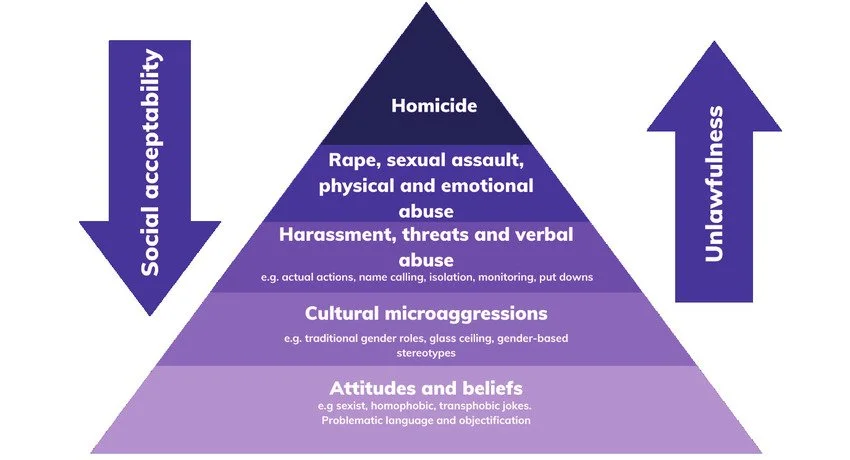
Walker, A., Barton, E. R., Parry, B., & Snowdon, L. C. (2023). Preventing sexual harassment through a prosocial bystander campaign: It’s #SafeToSay: This article is related directly to the First European Conference on Law Enforcement and Public Health (LEPH) held in Umea, Sweden in May 2023. Journal of Community Safety and Well-Being, 8(3), 130–138. https://doi.org/10.35502/jcswb.329
The good news: Men can transmute this legacy. I believe my family is evidence of that. My great-grandfather went to prison for incest, and his abuse rolled down generations. But my generation became like generational circuit breakers; the buck stopped here.
In The Will to Change, bell hooks writes, “The first act of violence that patriarchy demands of males is not violence toward women.” Rather, it’s “that they kill off the emotional parts of themselves.” Hooks exposes how patriarchy’s first violence is within men themselves, demanding they cut off their emotions. This creates a trickle-down effect of hate/violence. Returning to emotional capacity then isn’t just for women—it reclaims men’s humanity and well-being.
I believe that we’re at this inflection point, particularly in America. We’re seeing these different worlds, systems, and ways of living play out. One world is one of domination, violence, fear, shame, othering, hostility, misogyny, and patriarchy. And one is a world of connection, community, love, vulnerability, compassion, benevolence, justice, truth, and accountability. I believe then that the question becomes, which one will we feed?
This is where the seeds of change must begin—addressing these systemic problems, calling men in, and healing together. We must be better.