I’m sorry
This essay is part of a 30-day series I wrote two years ago leading up to the first visit to my childhood hometown in a decade
Among the places I visited in my hometown was the home of Mozelle, who was my babysitter for many years. Mozelle, and her husband Paul, owned a dairy farm, and oh did I learn a lot on that dairy farm. I learned boundaries, I learned how to get along with other kids, and I learned why you shouldn’t pee on an electric fence.
Mozelle kept a lot of kids, including my childhood best friend, who I was thrilled to spend some time with this week while visiting my hometown. Mozelle’s home was a revolving door for kids she babysat, neighborhood kids, cousins, and more. The love, community, and connection I sometimes didn’t experience at home, I very much felt there. In recent months I’ve recalled a lot of memories from my time there, and this morning there was a memory I hadn’t thought of in a long time.
There was an older kid, who I only remember coming to Mozelle’s occasionally. I would’ve probably been something like 5 or 6 years old, and he was a few years older. While we’d play together, I didn’t particularly like playing with him, because he could be a bully.
However, one afternoon, after the rest of the kids had left, we were playing a game of whiffle ball together. I don’t remember what exactly happened, but he evidently did or said something that I didn’t like. All of a sudden, with all the strength and might that I could muster, I ran toward him and pushed him into a thorny rose bush. Within moments, his white t-shirt was turning red with blood. I was overwhelmed with feelings—anger, shame, sadness, remorse.
It was probably one of the only times from my childhood that I ever got angry and actually acted on it. In the years that’d follow, whenever I’d feel anger, I’d completely push it down, and avoid it at all costs. It was in part because I saw the effects of anger in my childhood home, and I wanted nothing to do with a feeling that had the consequences that I saw. But on that day, I acted on it. And I felt horrible. I was sternly punished, and gave a heartfelt apology, and something like that never happened again.
I feel like we can all remember times from our childhood in which we did something we shouldn’t have, many times knowing that it was wrong, and then had to practice accountability, apologize, and make amends. There are countless other examples, like when I repeatedly left my toys out in the yard, when I forgot to take the trash out, when I forgot to feed the dog, when I hid my homework, when I didn’t practice my banjo, and much more.
What’s interesting, and truthfully sad, is that of all the things I feel like I learned and was told as a child, accountability, transparency, and apologizing was the thing that was least modeled to me by men. I can’t begin to tell you how lopsided it is the apologies I received from men as a child vs. women. Some people would argue that men have a higher threshold for what’s considered offensive behavior. Others may say that the line is often so gray for when something calls for apologizing. Intentions, actions, and perceptions can all be a bit grey after all.
I call bull shit. There’s crossing the line, and then there’s barreling past the line so fast, far, and hard that you’re in a different time zone. My experience as a child, especially with men, was the latter. My experience also was that men, no matter how heinous the offense, typically never apologized, repaired, or changed the offensive behavior. You can imagine the confusion then as a young child when I had to take accountability of my actions, apologize, and make amends, while many men, and especially caregivers, were doing far worse while accepting no accountability for their actions.
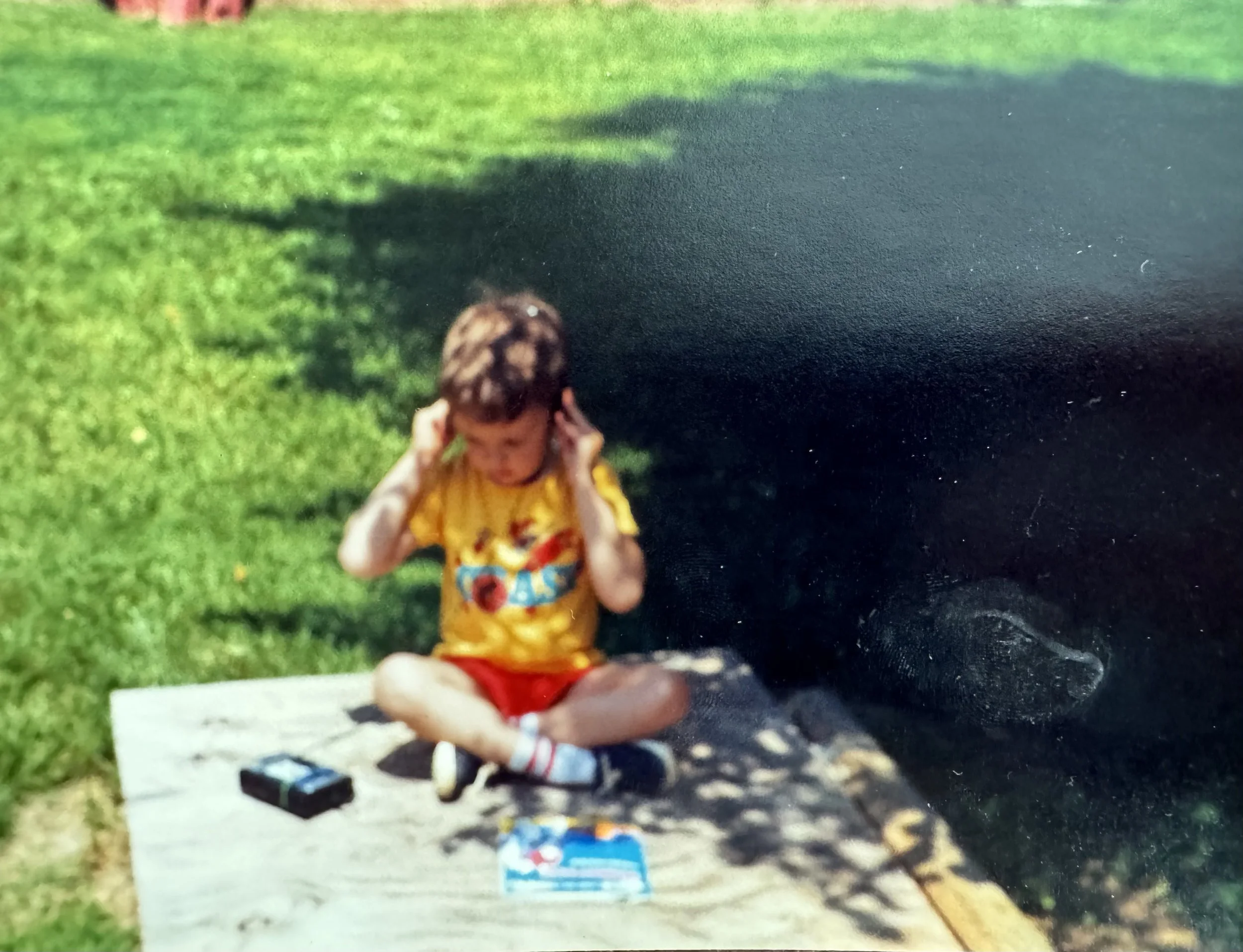
This was a common scene from my childhood. When life felt like too much, I’d often disappear to my backyard, and often into the woods, or in this case, to the grass to listen to music and read a book.
My visit to North Carolina was in part to visit my childhood hometown, but also to visit with my aunt, my mom’s best friend, who I hadn’t seen or really talked to in a decade. It, too, was something I felt like I needed to do. It was in part because I was taking accountability of how bad I’d been about staying in touch, and I didn’t want to just text, email, or call her to apologize.
Shortly after I arrived on Tuesday evening, we drove to what was one of my mom and aunt’s favorite restaurants, Cracker Barrel. On the drive I apologized, and told her I was sorry that while she’d been so good about sending cards and greetings for holidays and birthdays, that I’d been so bad about keeping in touch and had been rather ungrateful.
She graciously accepted my apology, but her first response really struck me. Immediately after I apologized, she responded, “Well, you’re a guy.” It was a little bit of a gut punch, as I realized my culpability in a patriarchal system where it’s normalized that men aren’t communicative.
I responded that being a guy is not an excuse for being uncommunicative. Nor is it an excuse for many other behaviors and thought patterns, which are often minimized with a saying like “boys will be boys.” F that. The behaviors and thought patterns of boys and men are often given the “it’s just locker room talk” treatment, absolving us of consequences, all while it often has a destructive impact on others, and especially women, marginalized communities, and people of color.
While my not staying in touch may be a small example, it speaks to a bigger problem. And it’s this type of bigger problem that I want to dismantle and change the culture and conversation of.
In recent years, particularly in the wake of the Me Too Movement and continued fight for social justice, there have been apologies, particularly from men, that are along the lines of, “I’m sorry you feel that way.” Or, I’m sorry that what I said offended you. News flash, that’s not an apology. Apologizing for how someone else feels is not accountability. And, what’s more, it doesn’t result in repair and change. It’s empty words for the self-protection of the offender.
There is a saying that the world is divided into people who think they are right. The more inadequate we feel, the more uncomfortable it is to admit our faults. Blaming others temporarily relieves us from the weight of failure. The painful truth is that all of these strategies simply reinforce the very insecurities that sustain the trance of unworthiness. The more we anxiously tell ourselves stories about how we might fail or what is wrong with us or with others, the more we deepen the grooves—the neural pathways—that generate feelings of deficiency. Every time we hide a defeat we reinforce the fear that we are insufficient. When we strive to impress or outdo others, we strengthen the underlying belief that we are not good enough as we are. This doesn’t mean that we can’t compete in a healthy way, put wholehearted effort into work or acknowledge and take pleasure in our own competence. But when our efforts are driven by the fear that we are flawed, we deepen the trance of unworthiness.” ― Tara Brach, Radical Acceptance: Embracing Your Life with the Heart of a Buddha
If I did something that hurt someone, insulted a group of people, disconnected a friendship, or resulted in conflict with a partner, then why wouldn’t I repair it when repair results in an increased capacity to love, reconnection, growth, and healing? In talking about love, psychologists and experts generally agree that every day it’s a choice to love and not just an inclination or passion that we feel and act on. Similarly, every day I want to commit to being better. A better what? Better at everything, because when I unlearn and heal something within myself, everyone benefits.
I’ve previously written about perfection, and how I ran headlong into perfection as a child and teenager, and it became my standard operating procedure. Yet I did so at the price of disconnection from myself and others. Perfection was a coping mechanism so that I didn’t have to feel those experiences and feelings that were uncomfortable to me. I was denying myself of the full-range of human experiences and feelings. And as I’ve written about ad nauseam, when we numb the bad stuff, we numb the good stuff.
Returning to therapy in 2022 began a journey of leaning into discomfort, insecurities, anxieties, and those things I resisted for so long. When I feel those uncomfortable emotions, I’ve found that it often means that it’s something I need to spend time with, because many of those feelings have been rooted in a bad experience from when I was young.
Part of this practice has meant asking others how I can be better, accepting feedback, and when moments have required it, apologizing. What’s come from it has been repair, healing, and greater connection to myself and others. This is the world and communities I want to exist and live in, where I can recognize my shortcomings, but also have them reflected back to me from others, and in doing so unlearn, learn, grow, heal, and be better. This is what I believe it means to live in community and connection with others. This is love.
“Pain and dysfunction get passed down from generation to generation. A mixture of genetic inheritance and environmental circumstance ensures that our lives unfold according to a complex web of conditions that is infinitely larger than ourselves. The only way to stop the vicious cycle of reacting to pain by causing more pain is to step out of the system. We need to let our hearts fill with compassion, and forgive ourselves and others.” ― Kristin Neff, Self-Compassion: The Proven Power of Being Kind to Yourself