The case for healthy masculinity
I and my family through generations have felt deeply the consequences and impacts of systems like patriarchy, sexism, and misogyny. It was my emotional inheritance. Coupled with my Christian fundamentalist upbringing, patriarchy was like the air I breathed. And so the deeper I’ve excavated and gone on my mental health journey, the more it’s felt like something of my life’s work to Gandalf those systems and create a new normal of moving through the world and being in relationship with myself and others. Yet I’m no authority on masculinity. I’m not an expert. I’m no teacher. I’m in the muck, actively trying to do the damn thing to unlearn patterns, build better patterns, and be a better man, brother, uncle, friend, neighbor, and human.
I have by no means been immune to propping up patriarchy. For years I upheld patriarchal gender roles that were rooted in Christian fundamentalism. Then there’s the divorce in my late-twenties, a byproduct of dishonesty and the shame I had about debt I was racking up. I’ll also own the immense privilege I’ve had and the ways I’ve perpetuated patriarchy. Nevertheless, there’s arguably no work I’ve done that’s been more important, and no work that I’m more passionate about than unlearning and undoing the system of patriarchy and speaking truth to the systems that perpetuate it.
This is my work, and I believe to an extent, it’s everyone’s work. Many men and groups of people would have us believe that men, and more specifically white men, are under attack. Yet the data and research suggests that it’s men who are both a danger to themselves and a danger to others. So I can’t blame women one iota for choosing that they’d rather be alone with a bear in the woods than a man.
Masculinity by the numbers
I’ll begin with some data from the Pan American Health Organization (PAHO), a specialized international health agency for the Americas, which shared findings of a report that found that one out of five men die before 50 in the Americas because of "socially constructed 'macho' behaviors". That’s 20% of men who die before 50 because of the traditional concepts and culture of masculinity. PAHO writes the following:
This concept of masculinity, or “machismo” as it is known in the Americas, leads to three overarching risks; risk to women and children, in the form of violence, sexually transmitted infections, and lack of shared responsibility in the home; risk to other men, such accidents, homicides and other violence; risk to self, such as suicide, accidents, alcoholism and other addictions.
There’s a lot more data I’ll get to, but I do want to stop here for a minute, as this in part informs the rest of this section. PAHO, in not so many words, is saying that the traditional concept of masculinity is bad for everyone, including the very people who are projecting traditional concepts of masculinity. It’s literally killing men and it’s also killing others. It’s good for no one. Got that?
Let’s look at some of these things more closely. Men have a 4x higher suicide rate than women, according to the Centers for Disease Control and Prevention (CDC), and suicide is one of the leading causes of death for men. At the link above, the CDC continues, stating that males make up 50% of the population but nearly 80% of suicides. Meanwhile, the powers that be want to scrub the CDC website for information that promotes gender ideology. Men have much bigger problems than “gender ideology.”
If you’re continuing to read, hoping that the stats get better, they unfortunately don’t. Men are far more likely than women to develop a substance use disorder (SUD). This study states that men make up 75% of SUD cases, while national data in this release found that men die of overdose at a 2-3 times greater rate than women.
The perpetrators of violence are also overwhelmingly male. As in 9 out of 10. And if you look at the stats of sexual assaults, not just in America, but other countries, too, it's often between 95-99%. The Violence Prevention Project, which has been tracking mass shootings for years, has found that males account for a staggering 98% of mass shooters. Men currently make up 93% of inmates in America. This data is terrifying.
It doesn’t get any better for boys and young men in the education system, either. Richard Reeves, who I consider one of the foremost researchers on the topic of masculinity, has written extensively about how boys are falling behind in school. He writes for American Compass that boys are falling the furthest and fastest behind. Reeves writes, “For every three women on college campuses there are only two men, and the gender gap in bachelor’s degree attainment is wider today, at 15 percentage points in favor of women, than it was in the opposite direction, at 13 percentage points in favor of men, when Title IX was passed in 1972.”
And then there’s the loneliness epidemic, which former U.S. Surgeon General Dr. Vivek Murthy declared as so in 2023. Dr. Murthy, in an 81-page report, declared that loneliness poses risks that are as great as smoking. Half of U.S. adults have experienced loneliness (*raises hand), while research shows that loneliness and social isolation increases the risk of death by 30%. As mentioned in this AP article about Dr. Murthy's report, the risks of loneliness are comparable to smoking up to 15 cigarettes per day. And men often bear the brunt of the loneliness epidemic.
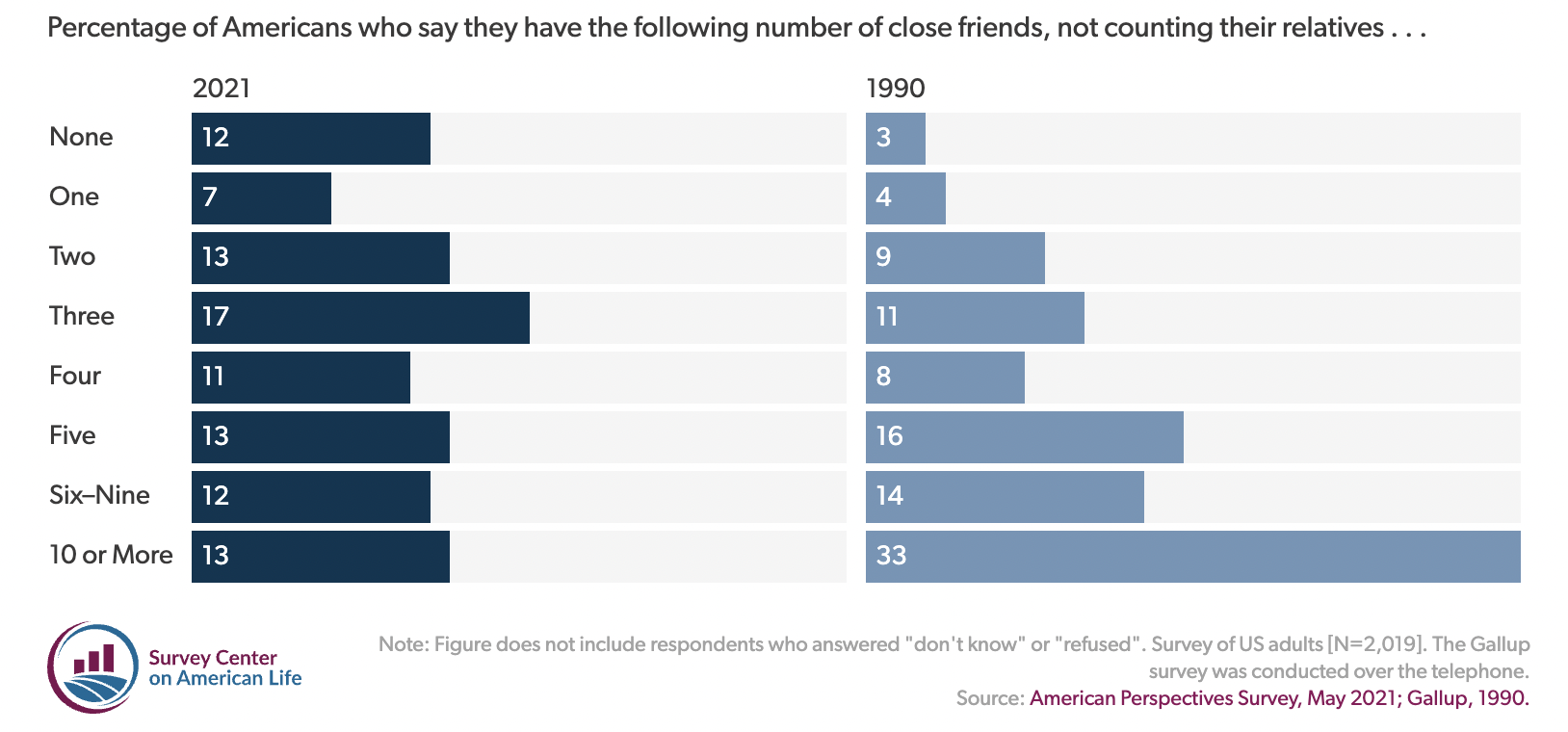
A PBS NewsHour report stated that just 21% of U.S. men say that they receive emotional support from friends every week, which is compared to 41% from women. An Americans Perspectives Survey found that approximately 1 in 7 men have no close friends, which is a fivefold increase since 1990. In other studies, like this one, the numbers are even higher of Americans who have no close friendships. A UK study of 1,000 men found that 40% of participants have never spoken to anyone about their mental health. It also found that it would take thoughts of suicide for them to do so.
This research and these stats are stark and not easy to read, and it’s all that much harder for people who’ve felt the harmful effects of a world governed by patriarchy. But I share all this to illustrate how dire this is. The state of masculinity in America, and in other countries, is killing everyone. It’s obviously harming and killing women and children, as evidenced by the percentage of perpetrators who are men. But it’s also killing the very men who are perpetuating the system and the men who think the system is benefitting them.
All the while, other cultures, who have greater equality, greater welfare and generosity, and more relationships, often have lower risks of dying, have better physical and mental health, live longer, and are happier. There are tons of studies, but you can find articles here, here, and here that highlight some of the research. You can also look at life expectancy in America, which is not good when set side by side with its peers. “The US has the lowest life expectancy among comparable countries, it far outspends its peers on health care,” writes the non-profit health policy organization, KFF.
At what point do we admit that the capitalistic, white supremacist, patriarchal ideal isn’t working? Let me say it a little clearer. What does the suicide rate and premature deaths of men have to get to until there’s acknowledgement that the system of patriarchy isn’t working? Because males already make up about 80% of suicides in America. Does it have to get to 90%? 95%? Because other stats, like the percentage of sexual assault perpetrators, percentage of inmates, and percentage of mass shooters who are males are already over 90%. It can’t get much higher.
Nevertheless, there are a lot of people (primarily white men), including those at the highest levels of leadership, who vehemently argue that men and masculinity are under attack, and that we need more, not less, rigid norms of masculinity.
Where do we go from here?
This is a lot. It’s unsettling and doesn’t paint a particularly hopeful future. Nevertheless, I’m hopeful and optimistic. Call me privileged, sentimental, soft, but I see and believe in the power of change. I’ve seen it in my own life—in the dismantling of systems of abuse and patriarchy that rolled down generations. I see it in people I follow on social media. And I hear it firsthand from friends and in groups I’m in, as men are confronting patriarchy, addressing their own patriarchal pasts, and making changes.
There’s no red pill for this or a 12-step solutions-oriented program, though a 12-step program to recover from patriarchal masculinity might be what many men need. I don’t have a quick remedy, and I’m not sure anyone does. But I hope here, and in future essays, that it’ll give a lay of the land, inform and inspire, stimulate more conversations, and move us forward. The rest of this essay, however, will be in service to some of my favorite authors on the topic of masculinity, while I’ll also share some encouraging studies.
When it comes to men’s and women’s issues and matters of love and the intersection of love, race, and gender, I always go to bell hooks, who I consider one of the foremost writers of our time, and who I wish we got more time with. She wrote what I consider one of the foremost books on masculinity, called, The Will to Change: Men, Masculinity, and Love. She pulls no punches when discussing patriarchal masculinity.
“Learning to wear a mask (that word already embedded in the term “masculinity”) is the first lesson in patriarchal masculinity that a boy learns. He learns that his core feelings cannot be expressed if they do not conform to the acceptable behaviors sexism defines as male. Asked to give up the true self in order to realize the patriarchal ideal, boys learn self-betrayal early and are rewarded for these acts of soul murder.” ― bell hooks, The Will to Change
What I experienced myself, and what I’ve observed in culture, is that there’s this fear and this stiff-arm of feminist qualities. There’s like this belief that a man can either be a hypermasculine man that’s a reflection of patriarchal, traditional gender roles and norms or they can be a feminine man. They can be the superior aggressive, strong, independent, determined, confident, dominant, stoic, aloof, and risk taking man who runs the world or they can be an empathetic, caring, humble, kind, soft, gentle, intuitive, patient, and creative, but inferior person, who’s more of a woman than a man and who gets run over. But there’s no in-between. Hooks recognized this train of thought and challenged it, saying:
“There seems to be a fear that if men are raised to be people of integrity, people who can love, they will be unable to be forceful and act violently if needed.... We see that females that are raised with the traits any person of integrity embodies can act with tenderness, with assertiveness, and with aggression if and when aggression is needed.” ― bell hooks, The Will to Change
Yet all too often men’s anger and aggression is rewarded while women’s anger is looked down on and considered out of line. Modern-day masculinity denies men (and women) the full human experience of being a human, all while projecting this superior system that in fact impedes progress, shortens lifespans, erodes physical and mental health, and is literally killing the very people it props up (and killing everyone else). “Patriarchy demands of men that they become and remain emotional cripples,” hooks writes.
Hooks continues, “Until we are willing to question many of the specifics of the male sex role, including most of the seven norms and stereotypes that psychologist Robert Levant names in a listing of its chief constituents―'avoiding femininity, restrictive emotionality, seeking achievement and status, self-reliance, aggression, homophobia, and nonrelational attitudes toward sexuality'―we are going to deny men their full humanity.” She then brings it home, playing off the words of Olga Silverstein:
“What the world needs now is liberated men who have the qualities Silverstein cites, men who are 'empathetic and strong, autonomous and connected, responsible to self, to family and friends, to society, and capable of understanding how those responsibilities are, ultimately, inseparable.' Men need feminist thinking. It it the theory that supports their spiritual evolution and their shift away from the patriarchal model. Patriarchy is destroying the well-being of men, taking their lives daily.” ― bell hooks, The Will to Change
One of my favorite voices on the subject of masculinity is Liz Plank. Her book, For the Love of Men, is a nuanced investigation of modern-day masculinity. And at the end of her book she calls for an end to the “so-called gender war.” Plank writes, “It has made us believe that if women win, then men lose, and vice versa.” She continues, “The gender wars myth has warped the conversation and led us to believe women’s and men’s problems are not connected and that spending time or resources on one doesn’t help the other when, in reality, it’s challenging the big overarching system that harms all genders that allows us all to thrive.”
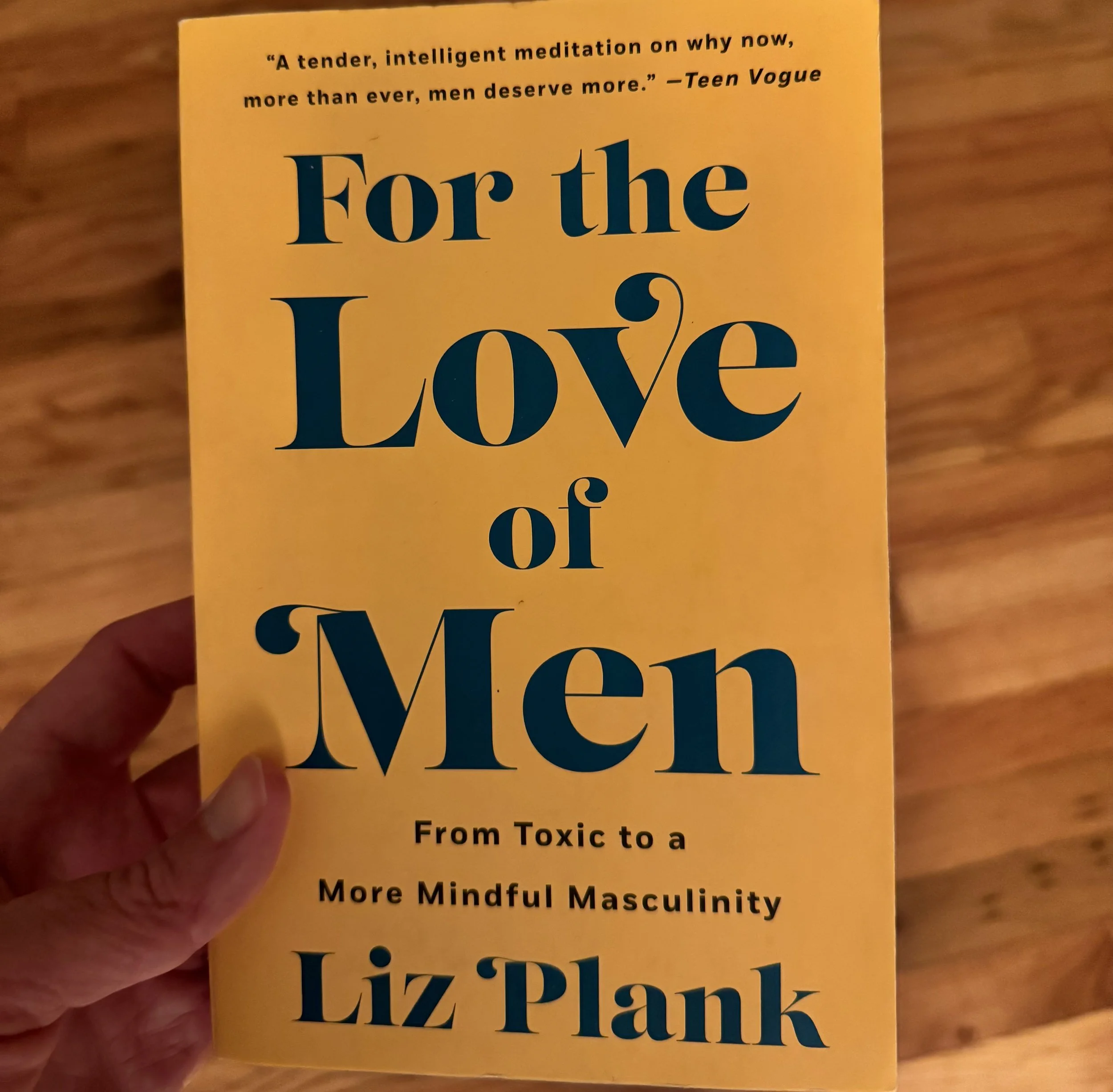
“Intentional masculinity is the cure for toxic masculinity,” writes Plank. She spends the last chapter making a case for a more “mindful masculinity,” which is a stark paradigm shift from masculinity as we’ve come to know it today. Many people may think of mindfulness, intentionality, awareness, and other similar attributes as weak. Plank argues, however, and I agree, that “practicing mindful masculinity requires courage,” which is one of the central tenants of traditional masculinity. A system, like patriarchy, which is aggressive, oppressive, and shaming, disempowers ourselves and disempowers others. That’s neither courage nor bravery.
“It’s by attending to masculinity that we can heal it. Mindful masculinity is how we can cleanse it from all the lies it’s been associated with. It encourages men to look inward to remain connected to all those things that make them a good man instead of the unhelpful trash they’ve inadvertently absorbed and are inadvertently carrying around about what it means to be a “real man.” Being mindful about our gender means we awaken ourselves to the habits and behaviors we’ve automatically come to identify with and choose which ones serve us and which ones don’t…The journey of conscious masculinity means being brave enough to examine pain as well as love and get knowledge and control over your life. It’s the ultimate form of protecting others, because there’s no greater way to show love for others than by taking responsibility for yourself.” — Liz Plank, For the Love of Men
A healthier paradigm of masculinity is a win-win
I’m wrapping up my Master’s of Science in Positive Psychology. And hands down, my favorite class thus far has been a meditation and mindfulness class. So of course I love that Plank makes a case for a more mindful masculinity. The culmination of my meditation class, after weeks of reading and reviewing the research about the science and impact of meditation, was to develop a treatment plan for individuals with PTSD. And one of the most interesting things I discovered was the impact of meditation for veterans (who are primarily male at nearly 90%).
NBC News highlighted one such study a few years ago. In the study of 200 San Diego veterans (mostly men), the participants were assigned to one of three different groups that focused on different modalities. One group attended classes on exercise and nutrition, one got exposure therapy, and the third learned to meditate. After three months, the meditation group improved on a PTSD assessment by 61%. The exposure therapy group improved by 42% and the group who went to classes improved by 32%. The impact of meditation was significantly greater than other more traditional therapeutic modalities.
There are countless other studies, too, that illustrate the impact of mindfulness on veterans. Another study, of a small group of veterans with PTSD, found that 50% of the participants (mostly men) no longer met the criteria for PTSD after just three months of transcendental meditation. What's more, it found reductions in depression and anxiety. Another study, a VA study, found that a 12-week course of loving kindness meditation was just as effective as one of VA’s front-line treatments – cognitive processing therapy (CPT) – for treating PTSD.

I bring this up regarding veterans because most veterans are men and there just isn’t much research at all about the impact of meditation for men. Nevertheless, I do want to mention that there are studies that have shown that meditation can have adverse effects, like anxiety or re-triggering trauma. That’s why I think it’s so important to have a safe container for learning and practicing meditation. But by and large, the research is overwhelming of the positive impact of meditation.
Now all of this doesn’t necessarily prove that mindfulness and meditation alone directly makes men healthier. But we have to start somewhere, and I believe that fostering a deeper connection to one’s self is a good starting point for undoing and healing what traditional masculinity is doing to men. Because let me be clear, what men are facing is a health crisis.
But as important as connection to one’s self is, so is connection to others. And as I previously mentioned, men have fewer and fewer close friendships. As that Americans Perspectives Survey highlighted, 1 in 7 men have no close friends, which is a fivefold increase in the last 30 years, and they have a 4x higher suicide rate than women.
Do you want to guess what one of the most important and longest-running studies found is the most important factor for happiness? Sex is not the correct answer, nor is career success, money, pizza, football, or fight club.
The 87-year study (which you can learn more about in the video below) conducted by Harvard found that the most important ingredient for a happy life is quality relationships. Elsewhere, a clinical review of nearly 150 studies found that people with strong relationships had a 50% better chance of survival. On the other hand, loneliness significantly increases the risk of dying early. The quality of our relationships dictates the quality of our life.
Beyond the individual and one’s connection to themselves and others, the system and society that individuals live within is of utmost importance. Like I previously mentioned, many of the countries that have the greatest gender equality are the happiest and have some of the longest lifespans, as articles here and here highlight. In a Suback essay, I wrote about how many Northern European countries are considered the happiest year after year. Many of them also top lists of countries with the most equality. And they frequently have some of the longest lifespans in the world, low unemployment rates, and are among the healthiest countries in the world. I can tell you now that America is at the top of no such lists.
There seems to be this belief in America that masculinity is under attack—as if there’s this joint effort to emasculate men. It’s almost as if many people see their gender, and in this case masculinity, as if it’s a pie chart, and that once you start taking away parts of “masculinity”, then the parts that are taken away must be replaced with femininity. Because god forbid anyone take away men’s ability to oppress, objectify women, be violent, and do or say anything they want without any repercussions, and then replace that with empathy, vulnerability, compassion, and awareness. Yet that seems to be so repulsive for many men.
But what’s scarier? The impact that more empathy, vulnerability, compassion, and awareness could bring men or the increasing likelihood of male violence, depression, suicide, and early death? The answer is so obvious. Empathy, kindness, and mindfulness, for example, have been proven to decrease stress, improve physical and mental health, extend life, and change people’s lives for the better (the proof is in the pudding here, here, and here). Yet at least in America, so many “leaders” and much of society is hellbent on doubling down on a patriarchal system that is bad for everyone and killing the very people the system acts like it’s protecting.
The response by some women is what’s become known as the “4b Movement.” It’s largely been credited as a movement that started in South Korea, with young women swearing off dating, sex, marriage, and children. But then in November, following the U.S. election results, there was a surge of interest of it on social media and in search engine searches.
As NBC News reports, the 4b movement was one of the most trending topics on Google following the election. And who’s to blame women considering the disparities, inequality, and increasing violence against women and just about every other group that’s not white male? I’m a firm believer in bodily autonomy and the empowerment of women, and so I believe that what women choose is ultimately up to them. I love how women are claiming agency, challenging systems, and creating new norms.
I do, however, want to briefly talk about one of the most commonly used phrases of the last few years, “toxic masculinity.” Personally, while I see why it’s used, I hate the term “toxic masculinity”. I believe that a term like “toxic masculinity” is often where the conversation begins and also where it often ends. If that’s where we’re starting the conversation, then we’ve already lost the group of people that we’re trying to reach. I simply don’t believe that inherent masculinity is the problem. Because I believe that both masculinity and femininity consist of traits that are within us all, regardless of our reproductive organs. So it’s here that I want to go back to the bell hooks quote from above.
“There seems to be a fear that if men are raised to be people of integrity, people who can love, they will be unable to be forceful and act violently if needed.... We see that females that are raised with the traits any person of integrity embodies can act with tenderness, with assertiveness, and with aggression if and when aggression is needed.” ― bell hooks, The Will to Change
I admit that for most of my life I fell into a trap of putting myself in these gendered boxes. There came a time, however, as a teenager, when I saw the alarming impact that the men around me—often the closest men to me who’d swore to be protectors and providers—were having on women and children. I witnessed how I, and other boys my age, were transforming. And I didn’t want any part of it. So I suppressed many feelings and traits often associated with masculinity, like strength, anger, aggression, confidence, and passion.
Yet at the same time I suppressed many feelings and traits associated with femininity, including nurturance, compassion, emotional awareness, tenderness, intuition, and creativity. Sociologist Michael Kimmel writes about this very disorientation that many young boys in particular experience, in which being a “good man” gets lost in the sea of boys and men trying to be “real men.”
I’ll end this section with another quote that I love from bell hooks about “good men”.
“For both men and women, Good Men can be somewhat disturbing to be around because they usually do not act in ways associated with typical men; they listen more than they talk; they self-reflect on their behavior and motives, they actively educate themselves about women’s reality by seeking out women’s culture and listening to women…. They avoid using women for vicarious emotional expression….
When they err—and they do err—they look to women for guidance, and receive criticism with gratitude. They practice enduring uncertainty while waiting for a new way of being to reveal previously unconsidered alternatives to controlling and abusive behavior. They intervene in other men’s misogynist behavior, even when women are not present, and they work hard to recognize and challenge their own. Perhaps most amazingly, Good Men perceive the value of a feminist practice for themselves, and they advocate it not because it’s politically correct, or because they want women to like them, or even because they want women to have equality, but because they understand that male privilege prevents them not only from becoming whole, authentic human beings but also from knowing the truth about the world…. They offer proof that men can change.” ― bell hooks, The Will to Change
Exploring solutions
I refuse to despair or give into the belief that men are toxic and/or incapable of change. Research that Michael Kimmel references suggests that there are reasons to be hopeful. In The Cut article I mentioned above, Kimmel refers to a survey of men, ranging from 18 to 60-plus, who were asked about appropriate workplace behaviors. “Nearly half of the men 30 and under said it was unacceptable to comment on a woman’s attractiveness, but more than three-quarters of the older men said it was just fine.” While it’s still unsettling how many men think it’s acceptable to comment on women’s attractiveness at work, I’m at least encouraged by the numbers going in the right direction with young men.
Other evidence is rather anecdotal, though giving me continued optimism and hope. A 2023 article in The Washington Post highlighted several different men's organizations that are creating spaces for men to better connect with themselves and other men. I myself have been in formal and informal group settings, where I’ve listened to men so vulnerably share their recent journeys of unlearning patriarchal masculinity and stepping into healthier models of masculinity that are improving their lives and the lives of those around them.
Mens groups like these are in part what inspired me to start Fellas Night In. And I absolutely love that major publications and even thought leaders, like Tim Ferriss, are having conversations about men’s groups. I recently came across this conversation below from 2022 between Tim and serial entrepreneur Kevin Rose, who talk about a men’s group led by therapist and author Terry Real.
A Call To Men is one of many men’s organizations that are committed to creating a healthier paradigm of masculinity. Since its founding in 2002, A Call To Men has trained more than a million people and mobilized hundreds of thousands of allies. I’ve seen the organization’s impact in the Pacific Northwest. My friend Matt Villano recently wrote an article for CNN about how one of Portland's local high schools, President Grover Cleveland High School, has a Healthy Masculinity Club that follows A Call To Men's curriculum. Every week a group of 25 young men meet together to “unpack sex, sexuality, gender, girls and more.”
The positive impact of group processing like this can be incredible, especially for a population that’s experiencing so little connection and such harmful health impacts. One study found that male-specific interventions reduced anger, increased self-reflection, and reshaped perceptions about "being a man." I’ve experienced the impact of group processing firsthand. There’s arguably nothing that’s been more impactful for me than attending regular processing groups. It’s been a transformational supplement to talk therapy, writing, and other mental health practices.
I believe that studies and stories like this that I’ve shared in this section are more important now that ever. The news, social media, and our day-to-day lives are inundated with stories of men doing things that are harmful to others, themselves, and the planet. And the research I’ve shared here about the men’s health crisis is a drop in the bucket to the mountain of research about men’s mental and physical well-being. Yet throughout America and across the world men are healing, growing, creating better relationships, changing themselves, and changing their communities for the better. I’d like to think that I’m evidence of that.
“How we talk about masculinity might be just as important, if not more so, than what we say. The very idea that there is a strict set of rules needs to be chucked away. The future of masculinity is a plethora of masculinities.” ― Grayson Perry, The Descent of Man
Bringing it home
I have a folder on my computer labeled “Ancestry,” which is filled with news clippings from the late-1800s and early 1900s. They mainly involve my great-great grandfather, who migrated to America from Germany when he was a kid in the late-1800s. His early years as a father were marked by heinous, abusive acts, some of which, landed him in prison for years. Most of his life from then on was largely estranged from his family. I don’t know what led him to be so abusive as an adult. But what I do know is that the trauma and abuse continued to roll down multiple generations of our family for a century.
My active participation in learning, and unlearning, my family history has been a journey of nearly 7 years, thousands of dollars in therapy, thousands of dollars in grad school classes, hundreds of pages of writing, scores of books, and hours of conversations. Yet there’s no work that I’ve done that’s been as important as this. It’s the best investment and gift I could gift to myself, and frankly, the best gift I could give to others.
I believe that when we heal the issues that are facing men, we heal the world. This is the work. Because the same patriarchal systems that propped up my great-great grandfather, plagued our family, rolled down several generations, and impacted scores of people, is the same type of system that’s wreaking havoc today.
I believe that challenging it, healing patriarchal masculinity, and creating new healthier systems for men to connect with themselves and each other is the work of my lifetime. I’ll end with this fantastic line from Tony Porter, co-founder of A Call To Men, who said at the end of his TED Talk, “My liberation as a man is tied to your liberation as a woman.” May we be instruments for each other’s liberation.